

Crimes of the Islamic Sharia law and History against Jews and Christians during Umar reign
Exposing the Islamic false propaganda about the Islamic Sharia and History
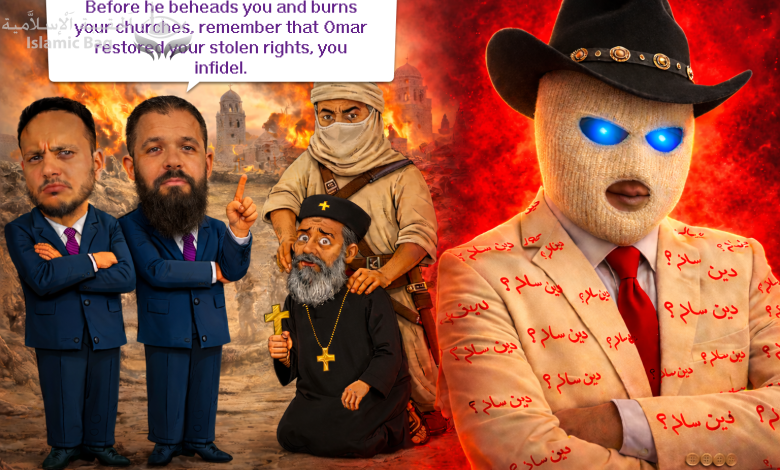
Crimes of the Islamic Sharia law and History against Jews and Christians during Umar reign
By Nickolas Rock
 The worst evil that can come on humanity if a country is ruled by Islamic Sharia law. In today’s article we take as example the Second Kalif Umar Ibn Al Kattab and his ruling law known as ِAL SHOROOT AL UMARIAH in English “The Conditions of Umar” and following will be its content along with the reference book by Ibn Al Qayim who is the disciple of Ibn Taymiah called “The rulings concerning the People of the ZEMMAH”
English Translation of the Pact (Conditions) of Umar
In the name of God, the Most Merciful, the Most Compassionate.
This is a letter from the Christians of such-and-such city to the servant of God, the Commander of the Faithful.
When you came to us, we asked you for protection for ourselves, our children, our property, and the people of our religion. We made the following conditions upon ourselves:
We will not build in our cities or in their surroundings any new monastery, church, hermitage, or monk’s cell.
We will not repair any of these buildings that may fall into ruin if they are located in Muslim quarters.
We will not display our crosses or our books in the public roads or markets of the Muslims.
We will not ring our church bells loudly nor raise our voices in prayer when Muslims are present.
We will not show our religion publicly nor seek to convert anyone to it.
We will not prevent any of our relatives from embracing Islam if they wish to do so.
We will respect the Muslims and rise from our seats when they wish to sit.
We will not imitate them in dress, headgear, footwear, hairstyle, speech, or titles.
We will not ride on saddles nor carry swords or other weapons.
We will not sell wine.
We will cut the front of our hair and wear distinctive clothing wherever we are.
We will not display the cross or the Book in the roads of the Muslims.
We will not bury our dead near Muslim cemeteries.
We will not buy slaves who have been captured by Muslims.
We will guide Muslims and give them lodging for three days if they require it.
We will not spy for enemies nor hide any deception against Muslims.
If we violate any of these conditions, the protection granted to us will be void, and the Muslims will be permitted to deal with us as they deal with people who break their agreements.
The Pact (Conditions) of ʿUmar: A Critical Look at a System of Legal Humiliation
The so-called Pact or Conditions of ʿUmar is a set of regulations traditionally attributed to the caliph Umar ibn al-Khattab that governed the status of non-Muslim minorities—especially Christians and Jews—living under Islamic rule. These regulations appear in medieval Islamic literature such as Ahkam Ahl al-Dhimma by Ibn Qayyim al-Jawziyya and historical works like Tarikh al-Tabari by Al-Tabari. Classical Muslim jurists frequently cited these conditions as part of the legal framework defining the status of dhimmis—non-Muslims living under Muslim political authority.
From a modern perspective, however, the pact represents a system of institutionalized inequality that imposed humiliating restrictions on Christian minorities and other non-Muslim communities.
Institutionalized Religious Inferiority
The central idea behind the pact was that Christians and other non-Muslims could remain in their lands only if they accepted a subordinate legal status. Their rights were conditional rather than equal.
Among the commonly cited restrictions were prohibitions against:
- Building new churches or monasteries
- Repairing churches located in Muslim areas
- Publicly displaying crosses or religious books
- Ringing church bells loudly
- Attempting to convert Muslims
- Riding horses with saddles or carrying weapons
- Wearing clothing similar to Muslims
In several versions of the pact, Christians were also required to wear distinctive clothing or hairstyles to ensure they could be easily recognized in public. Such rules reinforced a visible hierarchy between Muslims and non-Muslims.
The practical outcome was the creation of a society where religious minorities were tolerated but permanently marked as inferior.
A System Designed to Humiliate
Some of the provisions appear explicitly designed to emphasize social humiliation. Certain versions of the pact required non-Muslims to stand up when Muslims wished to sit or to offer hospitality to Muslim travelers for several days.
These conditions reinforced a social order in which the dhimmi was not an equal citizen but a protected subject who demonstrated submission in exchange for security.
Medieval jurists often discussed this framework openly. In classical Islamic legal thought, the subordinate position of non-Muslims was not merely incidental but part of the intended social structure of the Islamic state.
Influence of the Sunnah of Muhammad
The policies attributed to ʿUmar did not develop in isolation. Many Muslim jurists understood them as extensions of precedents found in the Sunnah—the recorded sayings and actions of Muhammad.
Several elements commonly cited in Islamic tradition are viewed as foundational precedents:
- Expulsion policies: A well-known report in Islamic literature states that Muhammad declared that two religions should not coexist in the Arabian Peninsula, a policy later implemented during the caliphate of ʿUmar.
- Differentiation between Muslims and non-Muslims: Various reports emphasize maintaining visible distinctions in social identity between Muslims and others.
- Special taxation of non-Muslims: The jizya tax, mentioned in the Qur’an and elaborated upon in later jurisprudence, became a defining feature of the dhimmi system.
Within classical Islamic legal reasoning, the pact attributed to ʿUmar was therefore often interpreted not as a personal innovation but as a continuation of principles rooted in the earlier practices associated with Muhammad’s leadership.
Conflict with Modern Human Rights Principles
When evaluated according to modern international standards, the conditions described in the Pact of ʿUmar conflict sharply with widely accepted principles of human rights.
The United Nations adopted the Universal Declaration of Human Rights in 1948, affirming key freedoms such as:
- Equality before the law regardless of religion
- Freedom to manifest one’s religion publicly
- Freedom to establish places of worship
- Freedom from discrimination
Nearly every major restriction within the pact contradicts these principles. Limiting the construction or repair of churches violates freedom of religion. Requiring distinctive clothing constitutes religious discrimination. Preventing public expression of religious symbols restricts basic civil liberties.
Under contemporary legal frameworks, such policies would be considered violations of fundamental human rights.
Historical Impact
The Pact of ʿUmar played a significant role in shaping centuries of Islamic legal thinking about the status of non-Muslims. Jurists repeatedly cited it as a foundational precedent when discussing the limitations imposed on Christian and Jewish communities.
Even when enforcement varied across regions and historical periods, the underlying doctrine of religious hierarchy remained embedded in classical jurisprudence.
For many minority communities living under such systems, the legal message was clear: their presence was permitted, but their rights and dignity were conditional.
Islamic Evidence for the Genuineity of the Conditions of Umar
From the same book “The rulings concerning the People of the ZEMMAH” and page 1164 we the following two pages along with the translatation the arabic text

Which leaves no room for whom wants to deny it
Example of Umar Crimes against Christians
Ibn Al Dorayhim (Eighth Century Hijri), one of the Islamic Scholars who Ibn Hajar wrote about, saying that he was a jurist with a sharp and keen mind, he wrote a book called “The Correct Method Concerning the Reprehensibility of Employing the People of the Book as Scribes” having the following cover and copyrights info

In page 165 he documents Umar deeds regarding Christians and their churches

Conclusion
The Pact of ʿUmar represents one of the most influential legal frameworks governing non-Muslims in medieval Islamic societies. Its provisions established a structured hierarchy in which Christians and other minorities were allowed to live under Muslim rule only by accepting legal and social inferiority.
Viewed through the lens of modern human rights principles, the pact highlights a stark contrast between historical systems of religious hierarchy and contemporary ideals of equality and freedom. The evolution of international law—particularly since the adoption of the Universal Declaration of Human Rights—reflects a global rejection of legal systems that treat people as inferior on the basis of their religion.


